Interactive eLearning Case Study
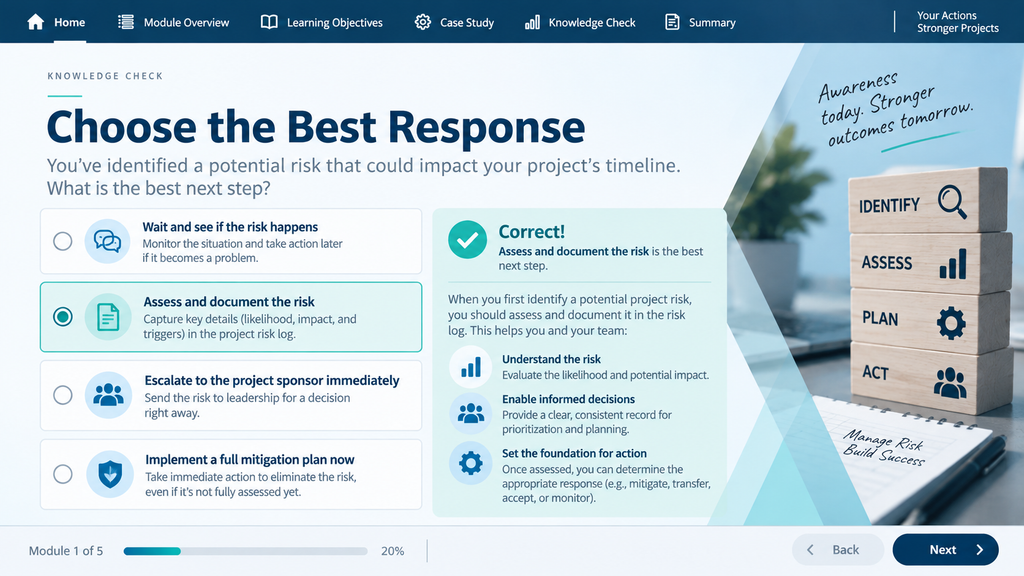
Project Type: Interactive eLearning / Risk Management Training
Audience: FAA Engineering Services personnel
My Role: Instructional Systems Designer / Course Developer
Responsibilities: Instructional design, Storyline development, interaction design, visual design, content organization, stakeholder/SME collaboration, and quality review
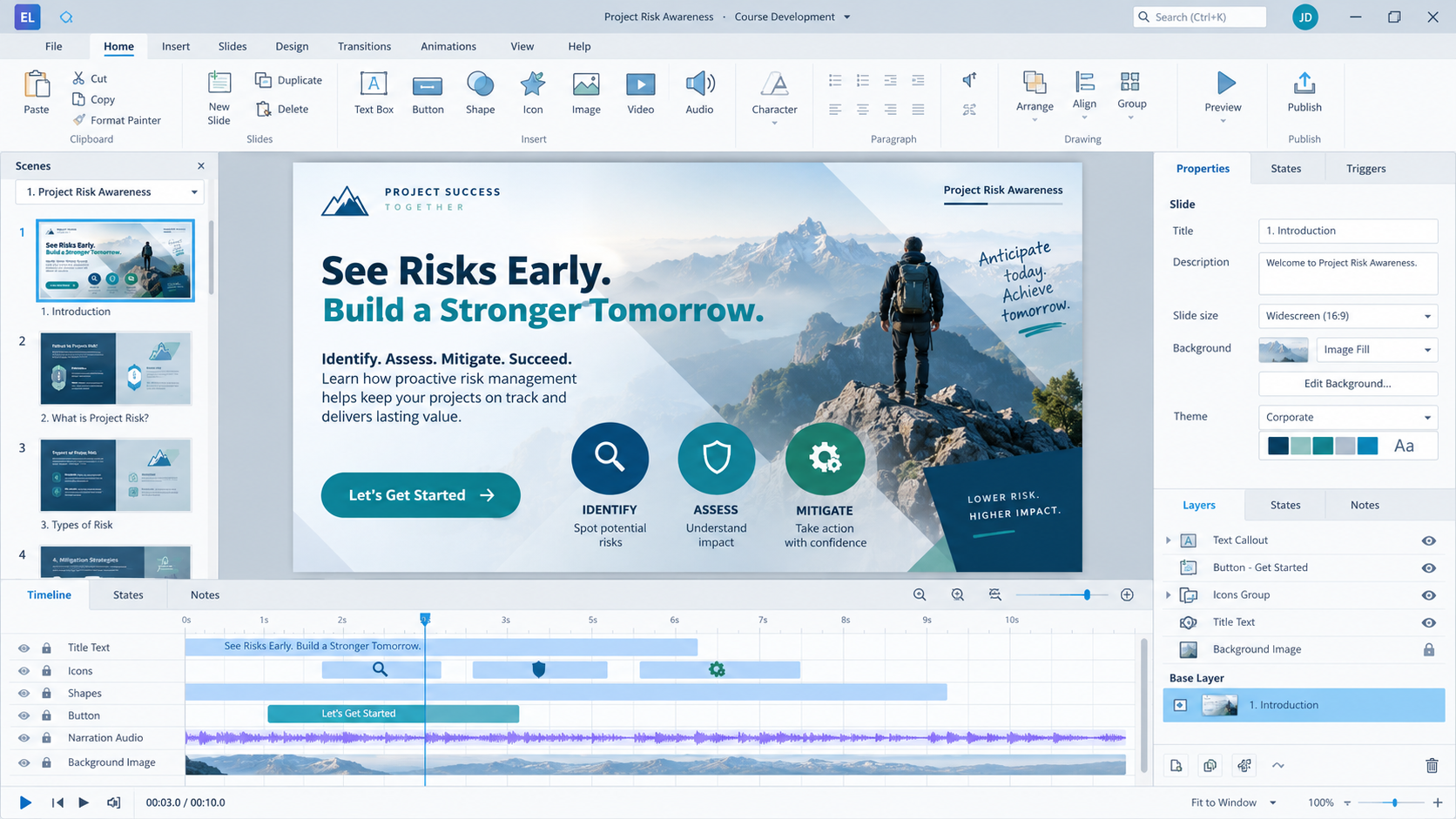
Primary Tool: Articulate Storyline 360
Focus: Applying operational risk-management concepts to project-related decisions
Portfolio Note: This project was developed for an internal FAA audience and contains proprietary and operational information. Original course materials, internal systems, and restricted content are not displayed. Examples and descriptions have been generalized to demonstrate my instructional design and development approach while protecting client information.
Overview
Project-Related Operational Risk Management was designed to help learners recognize, evaluate, and respond to operational risks associated with project work.
The subject matter involved concepts that could easily become procedural or text-heavy, so my goal was to create a learning experience that made risk-management principles more visual, interactive, and relevant to the decisions learners encounter in real project environments.
I served as the instructional designer and developer, transforming technical source content and SME input into an interactive Storyline course that emphasized application rather than passive review.
The Challenge
Operational risk management requires learners to understand more than definitions and procedures. They must be able to recognize potential risk, consider possible consequences, evaluate available information, and make appropriate decisions.
The challenge was to take a content-heavy topic and design an experience that encouraged learners to think through those decisions rather than simply click through slides of information.
The course also needed to communicate serious operational concepts clearly while remaining visually engaging and easy to navigate.
My Process
I worked with subject matter experts and stakeholders to identify the most important concepts, decisions, and potential misunderstandings associated with project-related operational risk.
I then organized the content around the actions learners needed to take and designed interactions that allowed them to explore information, evaluate situations, and receive meaningful feedback.
Content Analysis → Learning Objectives → Storyboard → Visual Concept → Interaction Design → Storyline Development → SME Review → Revision → Quality Assurance
Interaction Design
Articulate Storyline allowed me to move beyond a traditional presentation-style course and create interactions that required learners to actively engage with the content.
Rather than presenting every concept in a linear sequence, I used interactive elements to reveal information progressively, reinforce relationships between concepts, and allow learners to explore content in a more purposeful way.
Feedback was designed to explain why a response or decision was appropriate, helping learners connect course concepts with practical risk-management thinking.
Visual Design
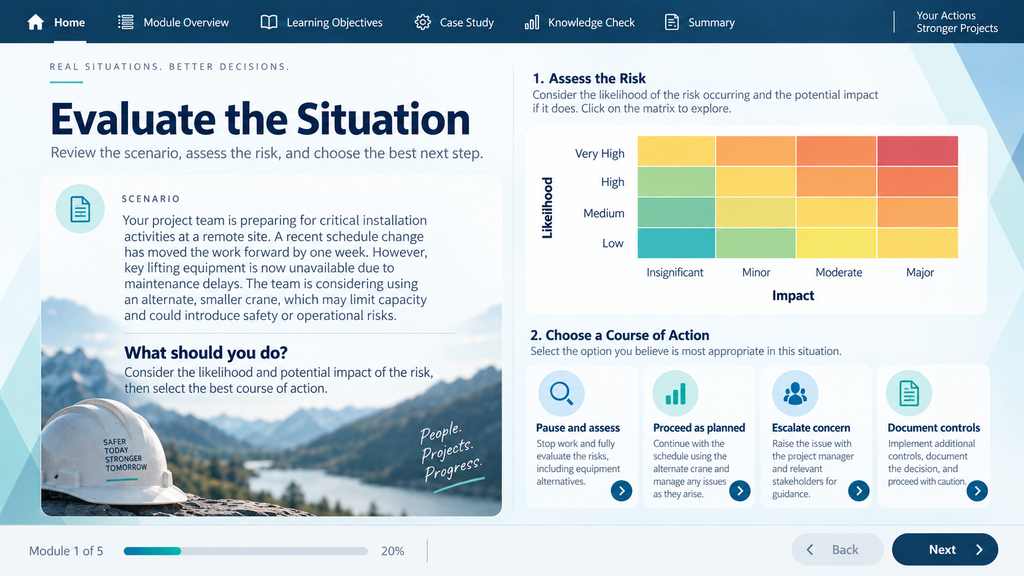
Visual design played an important role in making the course approachable. I developed a consistent visual treatment that supported the subject matter without overwhelming the learner.
Layouts, icons, graphics, typography, and interactive elements were used to establish hierarchy and guide attention toward key decisions and risk considerations.
This project also gave me an opportunity to use Storyline more creatively, combining instructional structure with custom visual treatments and interactions rather than relying primarily on standard slide templates.
Applying Risk Management Concepts
The learning experience was designed to help participants consider questions such as:
- What potential risks are present?
- How likely is an adverse outcome?
- What could the impact be?
- What actions could reduce or control the risk?
- When should a risk be elevated or communicated?
- How should risk considerations influence project decisions?
Results and Impact
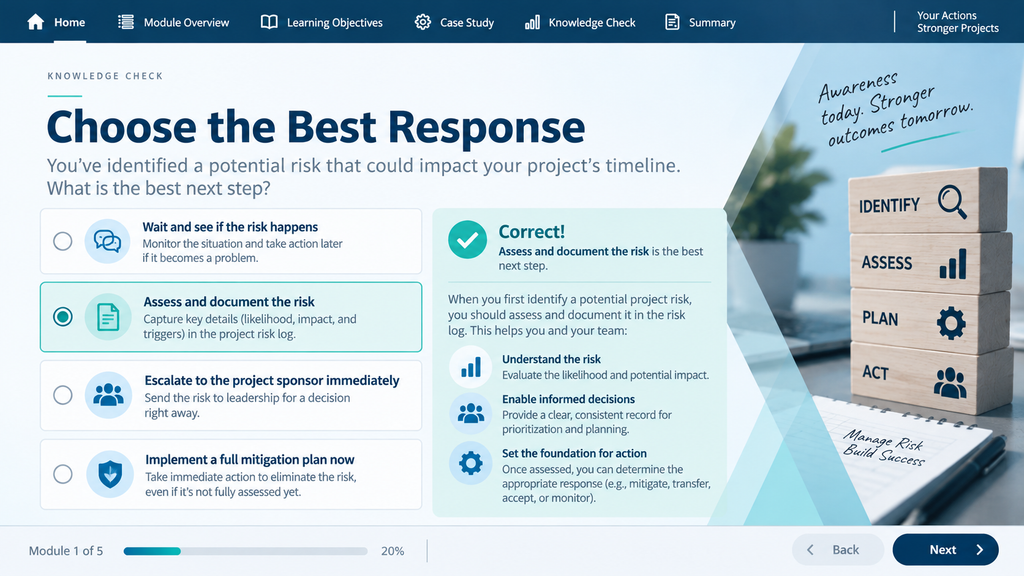
The completed course transformed complex operational risk-management content into a structured, interactive learning experience designed to support better project-related decision-making.
Using Storyline allowed the training to combine technical accuracy with visual design, learner interaction, and meaningful feedback. The result was a more engaging way to explore risk-management concepts while maintaining the seriousness and clarity required by the subject matter.
What This Project Demonstrates
This project highlights these abilities:
- Advanced Articulate Storyline development
- Interaction and experience design
- Visual treatment of complex subject matter
- Translating technical content into learner-focused instruction
- Scenario- and decision-based learning
- SME and stakeholder collaboration
- Designing meaningful feedback
- Balancing creativity with technical accuracy